Online Barefoot Bodywork Course for a Structurally-Oriented Practice
SARGA.Rx Online
$250.00 USD
SARGA.Rx Online is a self-paced barefoot bodywork course that teaches you how to integrate client-active movement, assessment, and corrective exercise into a structurally-oriented myofascial practice, using both feet and hands for lasting change.
This online course provides 5.5 continuing education units upon completion (NCBTMB #1413).
While other body therapies have similar goals as structurally-oriented bodywork, none are as touch-centered. Massage therapists are trained and licensed for the most encompassing scope of therapeutic touch, and thereby have the most powerful tools to facilitate brain-body connections. This presents a unique opportunity to facilitate structural and functional change for clients, but too often these changes are either unoptimized or unnoticed because client movement and assessment practices are not being implemented. My hope is that this "course" is less of a course and more of a conversation; one that encourages massage therapists to better utilize the powerful tools at their fingertips and helps to steer treatment strategies away from a prescriptive, one-size-fits-all approach.
— Daniel TsukayamaSARGA.Rx Instructor
This course was created for:
Practitioners who are interested in a structurally-oriented bodywork practice.
Practitioners who want to learn powerfully therapeutic client-active myofascial manual therapy techniques.
Practitioners curious about incorporating assessment and movement practices into their sessions using only their massage school curriculum as a foundation.
Barefoot bodyworkers who want to incorporate dynamic side-lying and seated techniques into their work.
Mat-based practitioners who want to incorporate barefoot myofascial manual therapy techniques into their existing repertoire.
What to expect in SARGA.Rx Online:
An introduction to structurally-oriented bodywork and goal-oriented sessions.
How to implement a collaborative client assessment style.
How to design a treatment strategy based on client goals.
How to integrate movement and corrective exercise into your client sessions.
How to shift from a “problem” approach to an exploratory approach in client sessions.
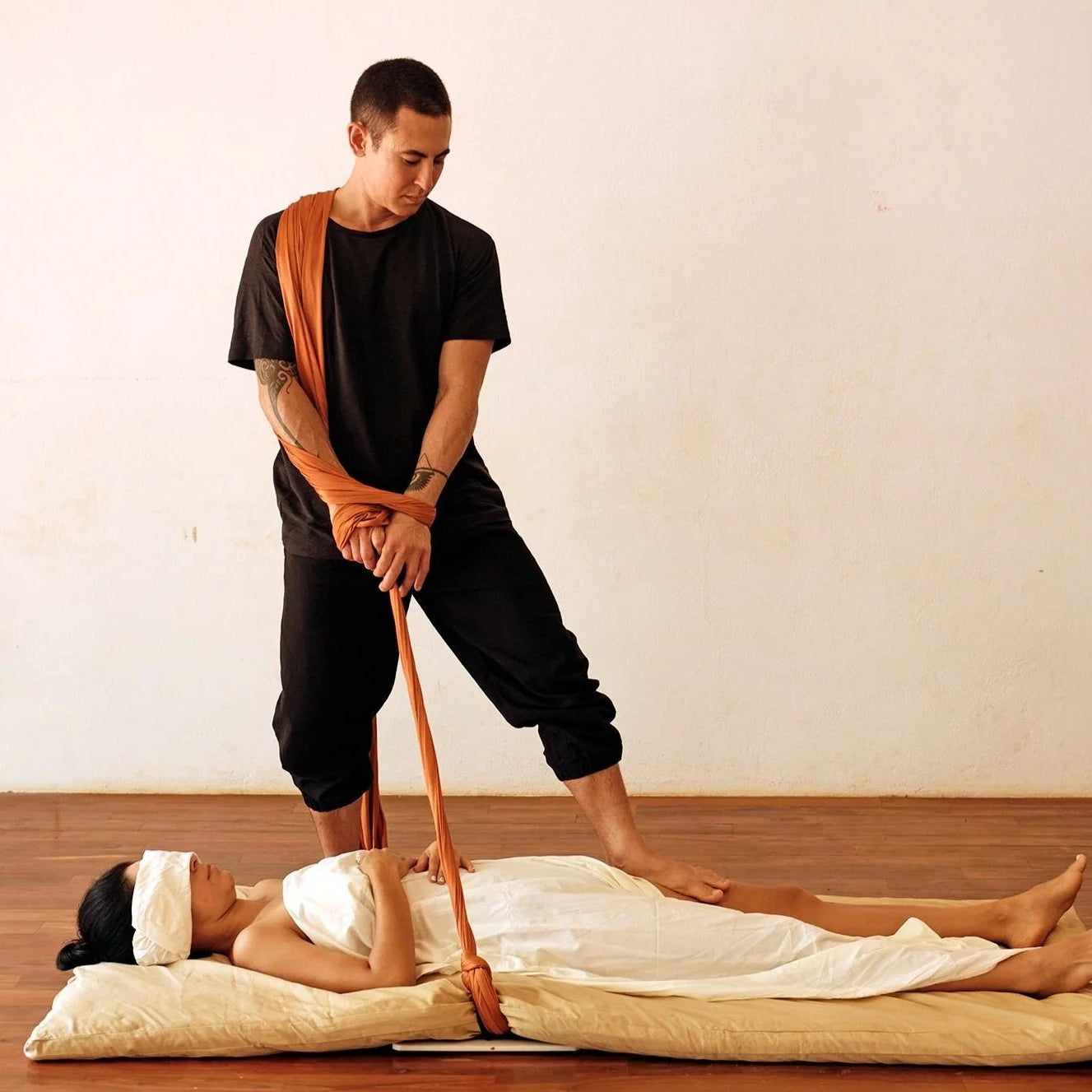
Powerful myofascial manual therapy techniques using barefoot applications for broad-contact techniques and the hands for detailed techniques.
Cautions & contraindications for barefoot bodywork.
Foot-based awareness, mechanics, care & sanitation.
Equipment setup for SARGA.Rx.
Meet Your Instructor
Co-Founder of Sarga Bodywork, and certified in Structural Integration, Daniel Tsukayama's bodywork practice is centered around the manual manipulation of fascia and how this affects the structure, expression and experience of the human body.
Frequently Asked Questions
Get answers to common questions about Sarga Bodywork training, techniques, and equipment.
Practitioners who are interested in a structurally-oriented bodywork practice.
Practitioners who want to learn powerfully therapeutic client-active myofascial manual therapy techniques.
Practitioners curious about incorporating assessment and movement practices into their sessions using only their massage school curriculum as a foundation.
Barefoot bodyworkers who want to incorporate dynamic side-lying and seated techniques into their work.
Mat-based practitioners who want to incorporate barefoot myofascial manual therapy techniques into their existing repertoire.
What kind of fitness is required for SARGA.Rx?
SARGA.Rx will absolutely get easier with practice, however learning this modality can be quite rigorous at first and excellent physical conditioning (particularly isometric strength), is a must in order to gain the most from a Sarga Bodywork course. Yoga, Pilates, dance, martial arts, or any full-bodied practice that encourages both strength and flexibility will help to condition you for practicing SARGA.Rx.
4 fitness measurements Here are four fitness measurements that can help to gauge your ability to learn and perform SARGA.Rx with success:
The ability to balance on one foot for at least 1 minute without holding onto anything for support.
Excellent cardiovascular conditioning and the ability to perform cardiovascular exercise (jogging, swimming, etc.) for 10-15 minutes without stopping.
The ability to perform at least 3 sets of 20 squats.
The ability to isometrically hold a plank for at least 1 minute.
If you would like some conditioning guidance to help you learn and perform SARGA.Rx with confidence, our Sarga Fit online course is an excellent resource designed with the fitness demands of SARGA.Rx and Sarga Bodywork in mind.
Why do you use your feet?
Feet are amazing manual therapy tools, and as bodyworkers, the ability to perform massage with our feet opens up a whole new set of biomechanical options.
Barefoot massage is an ancient practice, most notably in parts of Asia and the Pacific, and this practice encompasses manual therapy techniques that are applied to recipients' bodies with the practitioner's bare feet.
These techniques often mimic massage techniques applied with therapists' hands, however a notable difference is that barefoot massage techniques are less "pointed" and have the ability to deliver deeper, more consistent pressure due to the broader contact surface area of therapists' feet and the gravitational force that can be accessed for the delivery of the techniques.
What is myofascial technique?
The prefix “myo” refers to muscle tissue. Fascia is the connective tissue that forms a whole-body, continuous, 3-D matrix of structural support and wraps around every single cell, connecting cells to organs, organs to organ systems, and interpenetrates every muscle in the entire body.
We define myofascial technique as manual therapy characterized by slow, sustained, oblique, and high-tack contact with the aim of stimulating a stretch response in the fascia associated with muscle (myo) tissue (see shear-force).
Myofascial massage can help to treat muscle pain, inflammation and restriction, by relaxing contracted muscles, stimulating length and hydration in the tissue, and improving circulation.
What is bodywork vs. massage?
Referencing Mosby’s Dictionary of Complementary and Alternative Medicine:
Massage is the application of diverse manual techniques of touch and stroking to muscles and soft tissue to achieve relaxation and improve clients' well-being.
Bodywork applies therapeutic touch paradigms with the aim of restoring health and balance to the entire person by working through the body. In other words, the body is viewed as a doorway to access systemic health.
In-Person Courses vs. Online Courses?
We get this question a lot, and while we recognize that there is no substitute for in-person learning environments, especially for kinesthetic and touch-based trades, there are benefits and drawbacks to both in-person and online learning.
Online Courses Online education is a rapidly evolving interface that has made leaps and bounds in the last several years. Dynamic, intuitive, and user-friendly platforms have made digital learning increasingly seamless and effective. With Sarga Bodywork's online courses, you will gain access to a step-by-step learning experience that includes high-definition video instruction, accompanying written materials, and access to a private Facebook group for ongoing support. Here are a few key benefits of starting your Sarga Bodywork training online:
Learn from home!
Move through the course curriculum at your own speed.
Start with Sarga 101 Online to see if you like the material and join an in-person course later.
Lifetime access and archivable format gives students the ability to reference the material as needed.
Online course cost is more affordable than live courses.
No travel or travel expenses
In-Person Courses Sarga Bodywork's in-person courses are physically and mentally demanding, technique-based programs. A lot of material is packed into these courses and proficiency in the techniques is gained with subsequent practice of the material after class. Our curriculum is designed to build on itself, becoming more integrated with each day of class. Be sure to prepare your body and mind for a rigorous learning experience! Here are a few key benefits of starting your Sarga Bodywork training in-person:
Traditional, time-tested live learning format encompasses visual, verbal and kinesthetic learning styles.
Group classes help to facilitate accountability, feedback, and camaraderie.
Ability to receive real-time feedback from a skilled instructor.
Ability to feel the techniques from other students and an instructor.
Can't decide which track is best for you? Contact us to schedule a time to chat.
SARGA Marketing, Trademark & Patents
SARGA, SARGA BODYWORK, SARGATHAI, SARGSILKS, SARGA.RX, and MYO.RUB are trademarked names which are legally associated with the products, services, and methods provided by this business. Sarga Bodywork maintains trademark and intellectual property protections across multiple jurisdictions where our practitioners and instructors operate.
SARGA BODYWORK Practitioners may only use the trade name Sarga® and Sarga Bodywork® on marketing media once they has been certified as a Certified Sarga Bodywork Practitioner® in the proprietary methodology of Sarga Bodywork. Doing so without Sarga Bodywork certification is a legal infringement. In addition, select Sarga Bodywork equipment is exclusively available to practitioners who have completed our introductory in-person course or who have enrolled in Sarga Bodywork Beginner (101) Online, which reviews the proper installation and use of this equipment.
SARGATHAI, SARGASILKS & SARGA.RX Practitioners may only use the trade names above on marketing media once they have have attended the corresponding in-person course or have completed the corresponding online course. Doing so without these prerequisites is a legal infringement.
PROPRIETARY EQUIPMENT Other businesses and organizations may not use our proprietary equipment, or similar permutations, to teach massage technique. Our IP filings cover equipment for foot-based massage methods, consisting of a fabric strap or similar material attached to a client-supporting device and used by practitioners both for stability and to deliver therapeutic force to the client. We actively protect our proprietary methods and equipment designs internationally and will pursue legal action against unauthorized reproduction or infringement in any market where we operate.
Unauthorized use of our trademarks, patents, or proprietary methods may result in legal action, including cease and desist orders, monetary damages, and injunctive relief.
Choosing a selection results in a full page refresh.